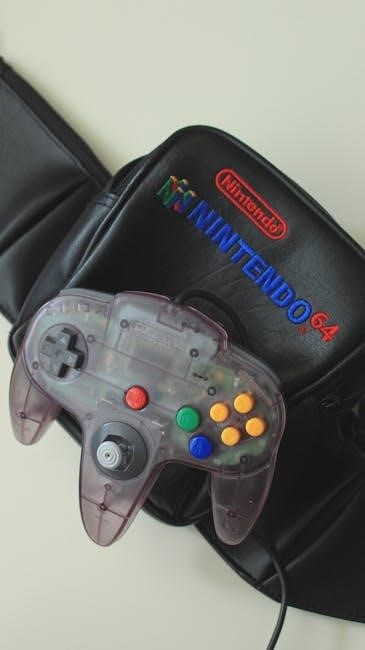
The Super Mario 64 manual served as the initial guide for players entering Princess Peach’s castle. It offered essential instructions,
world overviews, and gameplay hints, bridging the gap before widespread online resources existed.
Released alongside the Nintendo 64, the manual’s purpose extended beyond basic controls; it aimed to immerse players in the game’s expansive universe.
Historical Context of the Manual
The Super Mario 64 manual debuted in 1996, a pivotal moment for 3D gaming and Nintendo’s transition to the N64. It represented a shift from cartridge-based instruction to a more comprehensive guide for a complex experience.
Prior to the internet’s prevalence, physical manuals were crucial for understanding gameplay mechanics and navigating expansive worlds. The manual’s multilingual editions – including French, German, and Swedish – reflected Nintendo’s global reach.
Its existence is documented on platforms like Amazon and the Internet Archive, showcasing its enduring legacy as a collectible piece of gaming history.
Purpose of the Manual for Players
The Super Mario 64 manual aimed to equip players with the knowledge needed to conquer Princess Peach’s castle and rescue her from Bowser. It detailed the innovative controls, essential for navigating the game’s 3D environment, and explained Mario’s diverse abilities.
Beyond controls, the manual offered a glimpse into the game’s worlds, hinting at secrets and star locations. It served as a troubleshooting guide, addressing common issues players might encounter.
Ultimately, it was designed to foster independent exploration and enjoyment of this groundbreaking title.

Physical Characteristics of the Manual
The Super Mario 64 manual was a modestly sized booklet, typically printed on relatively lightweight paper stock. It accompanied the game, offering essential guidance.
Paper Stock and Print Quality
The Super Mario 64 manual utilized a standard, uncoated paper stock common for game manuals of the era. This choice prioritized affordability and weight, crucial for mass production and shipping alongside the Nintendo 64 console. The print quality, while functional, wasn’t exceptionally high, employing primarily full-color printing with a slightly grainy texture.
Images and text were clear enough for readability, but lacked the sharpness of modern glossy publications. The paper was susceptible to wear and tear, with edges easily becoming frayed or creased with handling. This contributes to the varying condition of collectible copies today.
Size and Dimensions
The Super Mario 64 manual adhered to a relatively standard size for Nintendo 64 game guides. Measuring approximately 5.5 inches (14 cm) in width and 8.5 inches (21.6 cm) in height, its dimensions were designed to comfortably fit within the Nintendo 64 game case alongside the game cartridge.
The manual’s thickness, consisting of 32 pages, contributed to a compact overall package. These dimensions facilitated easy storage and portability, aligning with the console’s focus on home entertainment and accessibility.
Cover Art and Design
The Super Mario 64 manual’s cover prominently featured vibrant artwork depicting Mario leaping towards Princess Peach’s castle. This iconic image immediately conveyed the game’s core premise and adventurous spirit. The Nintendo 64 logo and game title were boldly displayed, ensuring instant recognition.
The color palette was bright and inviting, utilizing shades of blue, green, and red. The overall design aimed to capture the whimsical and playful nature of the Super Mario franchise, enticing potential players to explore the game’s 3D world.

Content Overview: Core Sections
The manual systematically covered controls, character abilities, castle navigation, and world descriptions. It also detailed power-ups, star collection, enemies, and a helpful FAQ section.
Controls and Basic Gameplay
The Super Mario 64 manual meticulously outlined the Nintendo 64 controller’s functions within the game. It detailed Mario’s core actions: running, jumping, camera control, and utilizing the analog stick for nuanced movement.
Specific button mappings for actions like punching, kicking, and ground pounding were clearly illustrated. The manual also explained how to interact with the environment, collect coins, and enter paintings to access different worlds.
Furthermore, it provided a foundational understanding of the game’s objective – rescuing Princess Peach by collecting Power Stars – and how basic gameplay mechanics contribute to this goal.
Character Abilities and Movement
The Super Mario 64 manual dedicated significant space to detailing Mario’s diverse skillset. Beyond standard jumps, it explained long jumps, triple jumps, wall kicks, and backflips – essential for navigating the 3D environments.
The manual illustrated how combining these movements allowed for greater reach and access to hidden areas. It also touched upon swimming mechanics and the importance of precise timing for successful maneuvers.
Understanding these abilities was crucial, as the manual subtly hinted, for efficiently collecting Power Stars and mastering the game’s challenges.
Navigating the Castle and Worlds
The Super Mario 64 manual clearly explained the central hub – Peach’s Castle – and its interconnected worlds. It detailed how paintings acted as portals, each leading to a unique course filled with challenges and secrets.
The manual emphasized the importance of exploring every nook and cranny within each world, hinting at hidden stars and shortcuts. It also explained how collecting Power Stars unlocked new areas within the castle itself.
Mastering castle navigation and world exploration were presented as key components of progression.

Detailed World Descriptions (as presented in the manual)
The manual provided brief overviews of initial worlds like Bob-omb Battlefield, Whomp’s Fortress, and Jolly Roger Bay, highlighting key objectives and potential hazards.
Bob-omb Battlefield
The manual’s description of Bob-omb Battlefield introduces players to the first major world, a training ground for Mario’s 3D adventures. It details the presence of the mischievous Bob-ombs, emphasizing their use as both obstacles and tools for reaching higher areas.
The guide highlights the challenge of scaling the mountain, battling King Bob-omb, and collecting the Power Stars scattered throughout the battlefield. It subtly hints at secret areas and the importance of exploring every nook and cranny to uncover hidden rewards.
Players are encouraged to experiment with Mario’s moveset to overcome the terrain and enemies, setting the stage for the game’s core gameplay loop.
Whomp’s Fortress
The manual’s portrayal of Whomp’s Fortress emphasizes its verticality and the dangers posed by the Whomps – large, stone creatures that fall from the sky. It explains the fortress’s structure, built around a central pillar, and the need to navigate moving platforms and precarious ledges.
The guide details the objective of reaching the top of the fortress to confront King Whomp, warning players about the fortress’s crumbling nature and the importance of timing their jumps carefully.
It subtly suggests hidden pathways and the strategic use of Mario’s abilities to conquer this challenging level.
Jolly Roger Bay
The Super Mario 64 manual depicts Jolly Roger Bay as a unique underwater world, contrasting sharply with the other levels. It highlights the presence of Cheep Cheeps and other aquatic enemies, requiring players to adapt to underwater movement and combat.
The guide explains the importance of collecting the red coins scattered throughout the bay and navigating the sunken ship, hinting at hidden areas and challenges within its depths.
It subtly suggests utilizing the level’s currents to access previously unreachable areas, encouraging exploration.

Power-Ups and Items Explained
The manual details three key power-ups: Wing Cap, Metal Cap, and Vanish Cap. It explains their functions and how they unlock new areas and abilities within the game.
Wing Cap
The Super Mario 64 manual introduces the Wing Cap as a temporary power-up granting Mario the ability to fly. Activated by finding a Wing Cap Switch, it allows for exploration of previously inaccessible areas and shortcuts throughout the game’s worlds.
The manual emphasizes the limited duration of the Wing Cap’s effect, encouraging players to utilize it strategically. It also notes that mastering flight controls is crucial for efficient star collection and navigating complex levels. The manual provides basic instructions on controlling Mario while airborne.
Metal Cap
The Super Mario 64 manual details the Metal Cap as a power-up transforming Mario into a heavy, metallic form. This grants him invulnerability to most attacks and the ability to walk underwater without drowning, opening up new exploration possibilities.
The manual highlights the Metal Cap’s unique properties, such as increased weight and resistance to damage. It advises players to use this form strategically to overcome obstacles and defeat enemies. The manual also notes the limited time the effect lasts, urging quick and efficient use.
Vanish Cap
The Super Mario 64 manual explains the Vanish Cap allows Mario to become temporarily transparent and intangible. This unique ability enables him to pass through certain obstacles, like grates and walls, accessing hidden areas and shortcuts throughout the castle and its worlds.
The manual emphasizes strategic use, noting the cap’s limited duration. It suggests players utilize the Vanish Cap for puzzle-solving and exploration, carefully timing its activation to navigate complex levels. It also warns that Mario cannot attack while vanished.

Star Collection Guidance
The manual guides players on collecting Power Stars, essential for unlocking new areas of the castle. It details star requirements per level and offers basic finding tips.
Hints towards secret star locations are subtly included, encouraging exploration and rewarding observant players with hidden treasures.
Understanding Star Requirements
The Super Mario 64 manual clearly establishes that Power Stars are the key to progressing through the game. Players must collect these stars within each course to unlock doors leading to new worlds within Princess Peach’s castle.
The manual emphasizes that a certain number of stars are needed to access each section of the castle, gradually opening up more challenging levels. It doesn’t explicitly detail where to find every star, but it reinforces the importance of thorough exploration and completing objectives within each course to meet these requirements.
Successfully gathering the necessary stars is presented as the core loop of gameplay, driving players to revisit levels and master Mario’s abilities.
Tips for Finding Hidden Stars
The Super Mario 64 manual offers subtle guidance for locating elusive Power Stars, encouraging players to meticulously explore each level. It suggests paying close attention to the environment, looking for unusual features or areas that seem out of place.
The manual hints at secret passages and hidden blocks, implying that observant players will be rewarded. It doesn’t provide specific locations, but rather promotes a mindset of curiosity and experimentation.
Completing objectives and interacting with the world are key, as many stars are earned through fulfilling tasks or discovering concealed areas.
Secret Star Locations (as hinted at in the manual)
The Super Mario 64 manual delicately alludes to hidden stars without revealing precise locations, fostering a sense of discovery. It emphasizes the importance of thoroughly investigating each course, suggesting stars are often concealed within seemingly ordinary environments.
References to “hidden passages” and “secret areas” encourage players to experiment with wall jumps, ground pounds, and exploring beyond the obvious paths.
The manual’s subtle clues hint at stars found by completing unusual tasks or interacting with specific objects, rewarding dedicated exploration.

Enemies and Bosses
The manual briefly introduces common foes like Goombas and Koopa Troopas, alongside initial guidance for confronting bosses such as King Bob-omb.
It prepares players for challenges, though detailed strategies are largely left for in-game experimentation.
Common Enemy Types
The Super Mario 64 manual provides a foundational overview of the enemies inhabiting the game’s diverse worlds. It identifies familiar faces from the Mario universe, such as the mischievous Goombas, easily defeated with a jump, and the shell-clad Koopa Troopas, requiring a more strategic approach.
Boo’s are presented as shy ghosts, becoming vulnerable when Mario isn’t looking, while Chain Chomps are described as powerful, tethered beasts. The manual also acknowledges Piranha Plants, lurking within pipes, and Lakitu, tossing Spinies from above.
However, detailed behavioral patterns or specific weaknesses aren’t extensively covered, encouraging players to learn through direct interaction and observation within each level.
Boss Battle Strategies (initial guidance)
The Super Mario 64 manual offers limited, yet crucial, initial guidance for confronting the game’s imposing bosses. King Bob-omb is presented as vulnerable after being repeatedly grabbed and thrown, hinting at a strategic approach beyond simple attacks.
Whomp King’s weakness is subtly suggested through its unstable footing, implying the importance of disrupting its balance. The manual doesn’t detail precise attack patterns or timings, instead fostering a sense of discovery.
It encourages players to experiment and adapt, relying on observation and skillful execution to overcome these challenging encounters.
Frequently Asked Questions (FAQ) Section
The manual’s FAQ addresses common issues like controller functionality and clarifies core mechanics. It provides troubleshooting tips and ensures players understand fundamental gameplay elements.
Troubleshooting Common Issues
The Super Mario 64 manual dedicates a portion to resolving typical player difficulties. It addresses potential controller malfunctions, offering solutions like checking battery levels or ensuring proper connection to the Nintendo 64 console.
Furthermore, the manual provides guidance for situations where Mario falls through the floor or becomes stuck within the environment, suggesting specific actions to remedy these occurrences. It also briefly touches upon graphical glitches, advising a system reset as a potential fix.
These troubleshooting steps were crucial for players lacking internet access, offering self-help solutions to maintain gameplay enjoyment.
Clarification of Game Mechanics
The Super Mario 64 manual clarifies core gameplay elements for new players. It explains the significance of collecting Power Stars to unlock new areas within the castle and progress through the game.
The manual details how interacting with paintings transports Mario to different worlds, emphasizing exploration as a key component. It also briefly explains the concept of hidden secrets and the importance of thoroughly investigating each level.
These explanations were vital for understanding the game’s non-linear structure and encouraging players to experiment.

Safety Precautions and Warnings
The manual included standard Nintendo health warnings, advising breaks during play and caution regarding potential seizures. It also detailed the Nintendo warranty information.
Health and Safety Information
The Super Mario 64 manual, consistent with Nintendo’s practices, contained crucial health and safety information for players. It strongly advised taking frequent breaks during gameplay sessions to prevent eye strain and potential repetitive strain injuries.
Furthermore, the manual included a warning regarding photosensitive epilepsy, advising individuals with a history of seizures to consult a doctor before playing. Nintendo emphasized responsible gaming habits, prioritizing player well-being alongside the immersive experience. This section aimed to ensure a safe and enjoyable gaming experience for all users.
Nintendo’s Warranty Information
The Super Mario 64 manual detailed Nintendo’s warranty coverage for the game cartridge and console. It typically offered a limited warranty against defects in materials and workmanship for a specific period, usually 90 days from the date of purchase.
The manual outlined the process for claiming warranty service, emphasizing the need for proof of purchase and proper packaging. Nintendo clarified that the warranty did not cover damage resulting from misuse, accidents, or unauthorized modifications. This information protected both the consumer and the company.
Manual Revision History (if applicable)
Early printings of the Super Mario 64 manual featured slight variations in text and layout. Later revisions addressed minor errors or clarified instructions based on player feedback.
Identifying Different Print Versions
Determining a Super Mario 64 manual’s print version can be subtle, requiring close inspection. The initial North American release (NUS-NSME-USA) often features a specific layout and wording. Later printings might exhibit minor textual changes, such as altered phrasing in the FAQ section or slight adjustments to the troubleshooting guide.
Additionally, the back cover’s Nintendo of America logo and warranty information can offer clues. Examining the manual’s spine for print dates or revision codes is also helpful. Collectors often reference online databases and forums to cross-reference these details and accurately identify different print runs.
Changes Between Revisions
Revisions to the Super Mario 64 manual were typically minor, addressing errata or clarifying ambiguous instructions. Early printings sometimes contained typos or inaccurate depictions of gameplay mechanics, which were corrected in subsequent versions. These changes often involved refining the FAQ section to address commonly reported issues or expanding troubleshooting steps.
Notably, Nintendo didn’t implement substantial content alterations between revisions. The core gameplay guidance and world descriptions remained consistent. Collectors primarily focus on identifying these subtle textual differences as indicators of a manual’s specific print run.

The Manual as a Collectible Item
Super Mario 64 manuals, especially in pristine condition, hold value for collectors. Rarity depends on print run and condition, with complete copies fetching significant prices online;
Rarity and Value
The value of a Super Mario 64 manual is heavily influenced by its condition and the specific print version. Early print runs, particularly those with unique identifiers like NUS-P-NSMP-NEU6, can command higher prices.
Generally, manuals in excellent, uncreased condition, free from writing or tears, are the most desirable. Listings on platforms like eBay demonstrate that near-mint copies can sell for upwards of $20-$50, while damaged or incomplete manuals have significantly lower value.
Complete-in-box (CIB) copies, including the manual, naturally fetch a premium compared to loose cartridges. The collectible market recognizes the manual as a crucial component of the overall package.
Condition Grading
Grading a Super Mario 64 manual follows standard collectible guidelines. “Mint” signifies a flawless copy, virtually untouched. “Near Mint” shows minimal wear, perhaps slight shelf wear. “Very Good” exhibits some creases or minor blemishes, but remains complete and readable.
“Good” indicates noticeable wear, including creases, folds, or small tears, but no missing pages. “Acceptable” implies significant damage, potentially with writing or larger tears.
Collectors prioritize manuals free of writing, as this drastically reduces value. Accurate grading is crucial for fair transactions within the retro gaming community.

Digital Availability of the Manual
The Super Mario 64 manual is readily available online through resources like the Internet Archive, offering downloadable PDF versions for convenient access and preservation.
Internet Archive Resources
The Internet Archive hosts several digitized versions of the Super Mario 64 manual, providing a valuable resource for collectors and players alike. Specifically, the official NUS-NSME-USA manual is available for free download, borrowing, and streaming.
These digital copies allow preservation of this piece of gaming history, ensuring accessibility beyond the original physical copies. Users can explore the manual’s contents without needing to own a physical version, benefiting from its historical and instructional value. The archive’s commitment to digital preservation is invaluable.
PDF Versions and Online Access
Numerous websites offer PDF versions of the Super Mario 64 instruction manual for convenient online access. These digital formats replicate the original manual, allowing players to review controls, world descriptions, and gameplay tips on various devices.
The availability of these PDFs ensures the manual remains accessible even without a physical copy, preserving its historical significance. Online communities and retro gaming sites frequently host these files, fostering a shared resource for enthusiasts and researchers alike, aiding in game preservation.